Productivity Monitoring: Balancing Trust & Privacy
September 16, 2026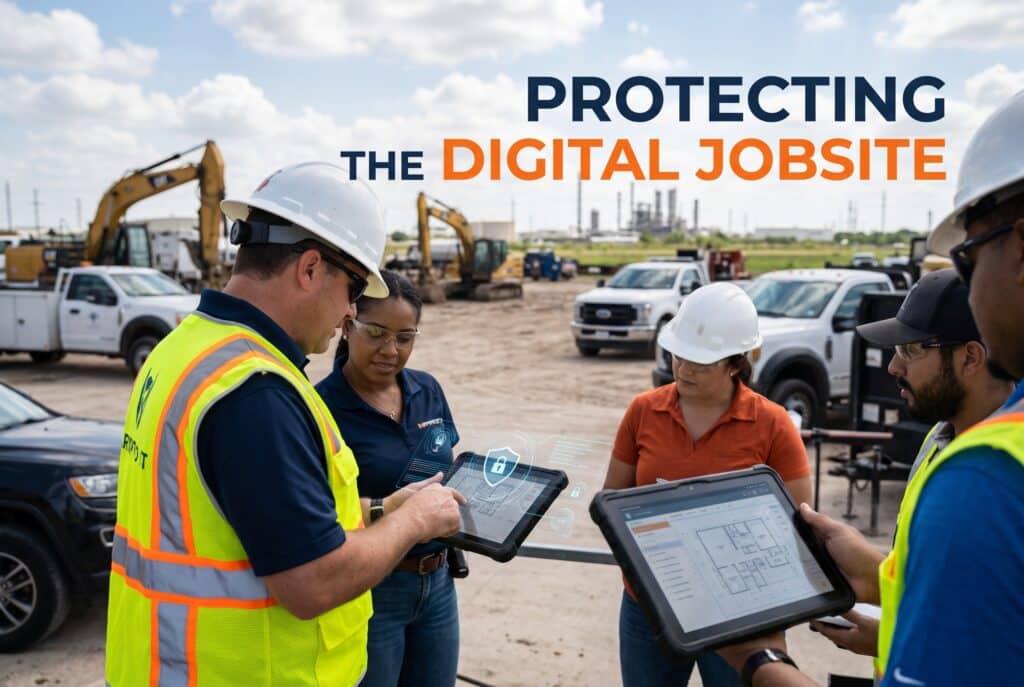
Walk onto almost any active site across Greater Houston today, and you will see just as much technology as heavy iron. Project managers are approving change orders on tablets from the cab of a pickup. Plant supervisors are monitoring automated assembly lines through connected sensors. Field engineers are pulling schematic updates from the cloud at remote wellheads, and dispatchers are tracking freight movements in real time across I-10 and the Port of Houston.
That connectivity keeps schedules tight and margins healthy—but it has also turned every trailer, warehouse, truck cab, and shop floor into an extension of your corporate network. Protecting the digital jobsite is no longer an abstract IT concern reserved for Fortune 500 companies but an ongoing Cybersecurity landscape to proactively defend all businesses. Cybersecurity for small and medium-sized business (SMB) owners and executives in Houston’s construction, manufacturing, oil and gas, and transportation sectors, securing field and office technology is directly tied to keeping projects on schedule and revenue flowing.
Why Field Operations Are Prime Targets
Cybercriminals know where the leverage is. In industries where a single day of downtime costs thousands of dollars in idle crews, missed delivery windows, or halted production lines, attackers count on business leaders paying a ransom just to get back to work.
At the same time, field environments naturally break the traditional “office walls” model of security:
-
Distributed hardware: Laptops, smartphones, and ruggedized tablets constantly move between home Wi-Fi, cellular hotspots, jobsite trailers, and client facilities.
-
Third-party overlap: General contractors, subcontractors, equipment vendors, and logistics partners regularly share portals, file links, and temporary network credentials.
-
Legacy equipment meets modern cloud: Many manufacturing plants and energy service firms rely on older operational machinery or field controllers that were never built with modern encryption in mind, yet now connect to business networks for reporting and remote diagnostics.
-
High-speed communication: When a superintendent or dispatcher gets an urgent email about a wire transfer, fuel invoice, or revised delivery manifest, pace often wins out over scrutiny.
If you are not actively protecting the digital jobsite, a single compromised tablet in a field trailer or an unpatched remote login can give an attacker a straight path into your accounting software, ERP system, or operational controls.
What Risk Looks Like Across Houston’s Core Industries
Every industrial sector uses field tech a little differently, which means the weak spots look different depending on how your crews operate.
Construction: Jobsite Trailers, Subcontractors, and Payment Fraud
Modern construction runs on cloud platforms like Procore, Bluebeam, and shared CAD repositories. Temporary jobsite trailers often rely on cellular routers or hastily configured local networks that lack the firewall protections of your main office. Meanwhile, business email compromise (BEC) remains a massive headache: attackers spoof subcontractor invoices or change-order approvals, banking on busy project managers authorizing fraudulent ACH transfers before anyone double-checks by phone.
Manufacturing: The Bridge Between the Front Office and the Plant Floor
On the shop floor, industrial control systems (ICS) and operational technology (OT) keep lines moving. When those systems sit on the same flat network as corporate email and accounting workstations, a routine phishing email clicked in the front office can spill over and freeze production machinery. Legacy controllers that cannot be easily patched require strict isolation so a breach on one side of the building never halts output on the other.
Oil & Gas: Remote Access and Supply Chain Exposure
Houston’s energy service firms, fabricators, and field operators face a dual challenge: securing remote field connectivity while protecting standing digital links into larger operators’ systems. Attackers frequently target mid-sized oilfield service companies specifically because they hold valuable engineering data and maintain trusted vendor connections to upstream and midstream partners. Forgotten VPN profiles, default passwords on field gear, and unmonitored vendor maintenance accounts are common entry points.
Transportation & Logistics: Fleet Connectivity and Dispatch Continuity
For trucking, freight, and logistics companies, operational uptime depends on electronic logging devices (ELDs), GPS fleet tracking, warehouse management software, and electronic data interchange (EDI) portals. If ransomware locks up your dispatch board or customer billing system, trucks sit at the yard and freight misses port cutoffs.
6 Practical Cybersecurity Steps for Protecting the Digital Jobsite
Securing field teams does not mean slowing them down with clunky logins or blocking access to the tools they need to do their jobs. The right approach builds guardrails that run quietly in the background.
-
Lock Down Every Login with Phishing-Resistant MFA Passwords alone fail—especially when crews log in from mobile devices in bright sunlight or noisy environments. Enforce Multi-Factor Authentication (MFA) across email, cloud project portals, VPNs, and accounting tools so a stolen password cannot open the door by itself.
-
Manage Every Mobile Device and Laptop Centrally Using Mobile Device Management (MDM), your IT team can enforce encryption, push automatic security updates, require screen locks, and remotely wipe company data if a phone or tablet is left at a jobsite or stolen from a truck.
-
Separate Office Networks from Field and Plant Operations Network segmentation ensures that guest Wi-Fi in a jobsite trailer, sensors on a plant floor, and administrative finance computers live in separate digital lanes. If one device gets infected, the threat stays contained instead of spreading company-wide.
-
Replace ad-hoc File Sharing with Controlled Access When sharing blueprints, CAD files, or manifests with outside vendors and subcontractors, use permission-controlled cloud folders with expiration dates rather than open public links or personal email accounts.
-
Audit and Retire Old Remote Access PathsThird-party equipment vendors and former contractors often retain remote login privileges long after a project wraps up. Review user lists quarterly and eliminate dormant accounts or legacy VPN tunnels that nobody actively uses.
-
Maintain Immutable, Tested Offsite Backups If an incident does occur, clean backups are your fastest path back to normal operations. Keep at least one copy isolated so ransomware cannot encrypt it, and run regular test restores to verify your recovery speed before an emergency hits.
Key Cybersecurity Takeaways for Business Leaders
-
Your perimeter is wherever your people work: Security has to follow the tablet, the service truck, and the plant terminal—not just the main office server closet.
-
Small gaps create big downtime: Most breaches in industrial and field-heavy businesses start with basic oversights like stolen credentials, unpatched routers, or flat networks rather than exotic hacking techniques.
-
Security protects your reputation with larger clients: General contractors, energy operators, and enterprise shippers increasingly require proof of solid cybersecurity controls before awarding contracts.
Frequently Asked Questions
What does “protecting the digital jobsite” actually mean? It refers to securing all the connected technology used outside a traditional office—including mobile devices, jobsite trailer networks, cloud project management tools, fleet systems, and plant-floor equipment.
Will tighter cybersecurity slow down my field crews or drivers? No. When configured properly—using single sign-on, managed devices, and modern cloud authentication—crews get faster, more reliable access to blueprints, dispatch logs, and work orders without constantly resetting passwords.
We already have antivirus software on our office computers. Isn’t that enough? Traditional antivirus only catches known malware on individual PCs. Protecting modern field operations requires 24/7 endpoint detection, email filtering against invoice fraud, mobile device management, and segmented networks.
Ready to See Where Your Field Operations Stand?
You shouldn’t have to guess whether a remote trailer, vendor login, or plant connection is leaving your company exposed. At Krypto IT, we help Houston businesses build practical, no-nonsense defenses tailored to the way your teams actually work in the field and on the floor.
Take the first step toward protecting the digital jobsite by scheduling a Cyber Security Evaluation & Assessment with our team today. We will help you identify hidden blind spots, strengthen remote access, and keep your operations moving safely.