Remote Wellhead Security: Protecting Field Assets
November 21, 2026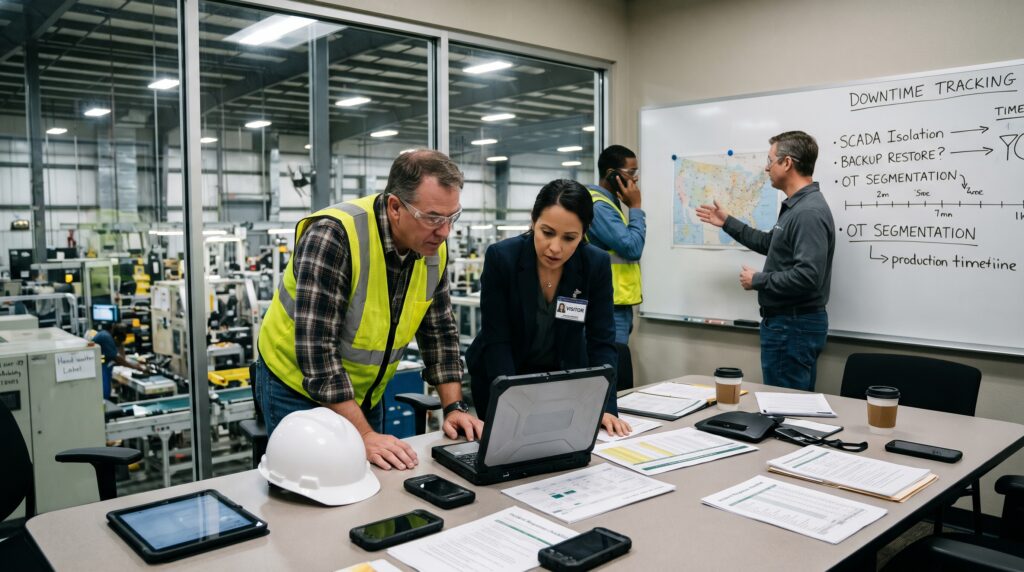
For any 24/7 production facility in Greater Houston, a smooth-running operation relies on a continuous flow of materials, labor, and data. However, if a ransomware attack hits your network, that steady progress stops instantly. When you run a round-the-clock operation, there is no good time for your systems to go offline. A sudden cyber incident will make your entire team painfully aware of the high cost of unplanned downtime.
Many industrial leaders only calculate the obvious losses, like missed shipment deadlines or idle labor. In reality, the true impact of a major cyber disruption is far more extensive. When a ransomware attack targets your Operational Technology (OT), it encrypts crucial production software, disables SCADA (Supervisory Control and Data Acquisition) systems, and locks historical data. If you lack a response plan designed specifically for the factory floor, a few hours of disruption can easily spiral into weeks of lost revenue and reputational damage.
Calculating the True Financial Damage of a Ransomware Outage
While most IT departments focus on data recovery, plant managers must focus on the immediate operational losses. To understand your actual financial exposure to unplanned downtime, you must calculate both the direct and hidden expenses.
1. Idle Labor Costs and Rushed Recovery
Even when your machines stop running, your payroll expenses continue. In a 24/7 environment, you are paying multiple shifts of specialized personnel to wait around while your IT team scrambles to diagnose the problem. If the recovery takes days, you will also face massive overtime costs for technicians working around the clock to restore your systems, alongside high emergency service fees from your outside vendors.
2. Upstream and Downstream Contract Penalties
In modern supply chains, late-delivery penalties and liquidated damages are common. If your facility stops producing, your customers will feel the impact immediately. missing critical deadlines can trigger severe financial penalties and, worse, force your partners to look for other suppliers who can guarantee on-time delivery.
3. Material Spoilage and Equipment Restart Failures
For process manufacturers, chemical plants, and food and beverage producers, a sudden halt is more than a timing issue. A sudden loss of control can ruin raw materials still inside your machinery, requiring hours of manual cleanout. Furthermore, Restarting complex industrial equipment after an emergency shutdown often leads to mechanical failures, scrap waste, and additional maintenance delays.
4. Severe Reputation Damage and Lost Business
Once word gets out that your operations have halted due to a cyber incident, you face a major crisis in trust. A prolonged period of unplanned downtime can cause your current customers to question your reliability and drive potential clients straight to your competitors, impacting your revenue long after your systems are back online.
Why Standard IT Incident Response Fails on the Factory Floor
Most corporate incident response plans are written with the office in mind. If your cyber strategy was designed primarily for email and shared drives, it will not protect your production line during a major incident.
In a typical corporate IT environment, the standard procedure when a threat is detected is to isolate and disconnect every affected device on the network. However, if your IT team applies that same rule to your OT network, they might shut down critical cooling systems, disrupt pipeline pressure monitors, or halt an active assembly line without warning. This can create severe physical safety hazards and lead to even more extensive unplanned downtime.
Industrial systems require a completely different approach. Your incident response plans must be designed to contain digital threats while keeping your physical equipment running safely. You must also account for the reality that many legacy controllers and SCADA hosts cannot simply be rebooted or patched without risking long-term operational damage.
5 Practical Steps for Building an OT-Specific Response Plan
To minimize unplanned downtime and protect your production lines during a cyber incident, your leadership team should implement five essential OT-focused response strategies:
-
Define Clear Containment Boundaries: Identify exactly which networks and devices can be isolated without shutting down your entire operation. A compromise in your shipping office or procurement system should never be allowed to spread to your main PLCs (Programmable Logic Controllers) or SCADA hosts. Establish segmented zones so your factory floor can continue running in “island mode” if necessary.
-
Establish Safe Out-of-Band Communications: Assume your corporate email, messaging apps, and phone systems will be unavailable during an attack. Set up a secure, pre-arranged communication plan using encrypted messaging or personal phone lines so your incident response team can coordinate without rely on your main network.
-
Identify Manual Overrides and Offline Procedures: If your automated control systems are compromised, do you know which processes can still be operated manually? document clear, step-by-step instructions for manual operation, bypass protocols, and paper-based tracking so your crews can keep production moving, even if at a reduced pace.
-
Keep Offsite, Immutable Backups of OT Assets: Having backups of your accounting files will not get your production line running again. Ensure you have dedicated, offline backups of your PLC configurations, HMI (Human-Machine Interface) programs, and SCADA settings. Keep these files in a secure, off-network location so they cannot be encrypted during a ransomware attack.
-
Run Regular Tabletop Simulations: Don’t wait for a crisis to find out if your response plan actually works. Gather your plant managers, engineers, and IT team to run practice scenarios. Testing your team’s response will help you spot gaps in your plan, clarify who makes the final decisions, and ensure everyone knows exactly how to get your systems back online quickly.
Critical Takeaways for Houston Industrial Leaders
-
A halt in production is your most expensive threat: The biggest financial damage of a cyberattack on a 24/7 operation is almost always the high cost of unplanned downtime, not the ransom demand itself.
-
Standard corporate IT plans will not protect your OT: Your response strategy must prioritize physical safety and keep your machinery running safely during a cyber incident.
-
Having Offline backups is essential for rapid recovery: You cannot restore your operations quickly without secure, offline copies of your specific PLC and HMI configurations.
FAQs About Resolving Industrial Outages
What is the average recovery time for a plant after a ransomware attack?
The timeline varies, but many facilities spend anywhere from several days to multiple weeks trying to get back to full production. The recovery speed depends on whether you have secure, offline backups and how well your team can implement their manual backup procedures.
How can we calculate our plant’s hourly cost of unplanned downtime?
To find your hourly rate, add up your average hourly revenue, your idle labor costs, and your estimated restart expenses. You should also include any contractual late fees and the cost of any wasted materials to get an accurate estimate of your financial exposure.
Should we pay the ransom to get our production line running faster?
Law enforcement and cybersecurity experts strongly advise against paying ransoms. Aside from funding criminal networks, there is no guarantee you will get your data back, and the decryption process can often take just as long as restoring your systems from your own offline backups.
Secure Your Production Line Before an Attack Shuts It Down
You shouldn’t have to wait for a major cyber incident to know if your production line can survive a ransomware attack.
Schedule a Cyber Security Evaluation & Assessment with Krypto IT today. Our Houston team will audit your industrial network boundaries, test your backup recoverability, and help you build a practical, OT-focused response plan to protect your 24/7 operations from the high cost of unplanned downtime.