The High Cost of Unplanned Downtime in Manufacturing
November 22, 2026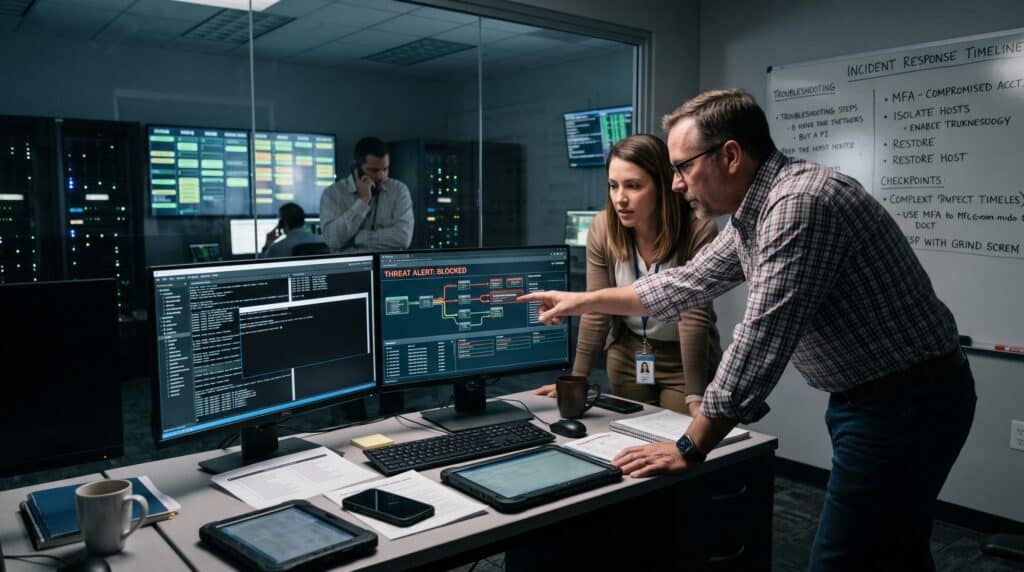
For years, small and mid-sized business owners operated under a comforting assumption: if a hacker slipped past a password or phishing filter, your IT team had days—or at least a full workday—to spot the intrusion and kick them out before real damage occurred. According to recent warnings from the FBI, that buffer has officially vanished. Federal cyber officials are alerting business leaders that AI cyber attacks can now recon, infiltrate, escalate privileges, and compromise a company’s network in under three hours.
What used to require a skilled team of human attackers typing commands manually for weeks is now being executed at machine speed. For executives across Greater Houston, this compression of the attack timeline changes everything about how you evaluate your current IT defenses. If your security strategy still relies on periodic log reviews, manual ticket escalations, or standard antivirus software, an automated intrusion can finish stealing your data or deploying ransomware before anyone even opens their inbox the next morning.
How Artificial Intelligence Compresses the Attack Timeline
To understand why the FBI is sounding the alarm, it helps to look at how generative AI and autonomous agents change the mechanics of a breach. Rather than inventing brand-new science-fiction exploits, attackers are using AI to eliminate human bottlenecks at every stage of an intrusion.
Automated Reconnaissance in Minutes
Previously, attackers had to spend days mapping out a target company’s public-facing servers, employee LinkedIn profiles, and unpatched software. Today, AI-driven scanning tools probe external firewalls, identify exposed remote desktop ports, and cross-reference known software vulnerabilities across thousands of businesses simultaneously in minutes.
Hyper-Personalized Phishing at Scale
Gone are the days of obvious typos and awkward grammar giving away a scam email. Attackers feed company websites, press releases, and leaked email threads into large language models to craft convincing spear-phishing messages tailored to specific executives, accounting clerks, or project managers—dramatically increasing click rates.
Rapid Lateral Movement Inside Your Network
Once an attacker gains a single foothold—often through a stolen employee login—AI cyber attacks use automated scripts to test internal permissions, harvest cached credentials, and locate high-value file shares or backup servers without tripping slow, traditional security alerts.
Why Traditional SMB Defenses Fail Against Machine-Speed Threats
Most Greater Houston SMBs have invested in baseline security tools: a firewall, spam filtering, and standard antivirus software. While those tools were adequate five years ago, they were built to stop known malware files—not intelligent, fast-moving AI cyber attacks that abuse legitimate administrative tools already installed on your computers.
-
Manual Alert Triage Is Too Slow: If your security system sends an email alert to an internal IT generalist at 11:30 PM on a Tuesday, and nobody sees it until 8:00 AM Wednesday, a three-hour breach was over five hours ago.
-
Signature-Based Antivirus Misses “Living-off-the-Land” Attacks: AI-assisted intruders rarely drop obvious virus files onto a hard drive. Instead, they hijack built-in Windows tools like PowerShell to move silently from workstation to server.
-
Single-Factor Logins Collapse Instantly: Automated credential-stuffing bots powered by AI can test compromised password combinations across cloud portals and VPNs at speeds no human firewall administrator can manually block.
Four Defensive Shifts to Counter AI Cyber Attacks
Surviving an era of AI cyber attacks does not mean your company needs an enterprise-sized cybersecurity budget, nor does it mean abandoning productivity tools. It means fighting automation with automation and closing the identity gaps attackers exploit first.
-
Deploy 24/7 Managed Detection and Response (MDR): You cannot fight a three-hour automated attack with 9-to-5 human monitoring. Managed EDR and 24/7 Security Operations Center (SOC) teams use behavioral AI to detect anomalous activity—such as an account suddenly dumping credentials at 2:00 AM—and automatically isolate the compromised endpoint in seconds.
-
Enforce Phishing-Resistant Multi-Factor Authentication (MFA): Standard SMS text codes can be bypassed by modern AI-driven phishing proxies. Upgrade to phishing-resistant MFA (such as authenticator apps with number matching or hardware security keys) across Microsoft 365, VPNs, and remote access tools.
-
Eliminate Standing Local Administrator Rights: When everyday employees operate with full administrator privileges on their laptops, any malware or script triggered by a phishing click immediately inherits those keys. Restricting administrative permissions stops AI cyber attacks from escalating privileges effortlessly.
-
Harden and Isolate Your Backups: Because fast-moving intrusions aim straight for recovery systems, ensure your backups are immutable, segmented from your primary Windows domain, and tested regularly for rapid restoration.
What Houston Executives Should Ask Their IT Provider Today
-
How fast do we isolate a suspicious device? Ask whether your current tools automatically quarantine an infected laptop at 3:00 AM, or if a human technician has to log in manually first.
-
Where are our blind spots across cloud and remote endpoints? With hybrid workforces and cloud apps, AI cyber attacks often start on an unmonitored home laptop before pivoting into corporate servers.
-
When did we last run an independent security assessment? Configurations drift over time, leaving legacy ports open or MFA disabled on newly created accounts.
Common Questions About AI-Driven Cyber Threats
Are small businesses really targeted by AI cyber attacks, or just Fortune 500 companies?
Small and mid-sized businesses are actually the primary targets. Automation makes it just as cheap and effortless for cybercriminals to launch AI cyber attacks against a 40-person firm in Houston as it is against a global corporation—and SMBs typically have fewer automated defenses in place.
Can employee security awareness training alone stop AI phishing?
Training remains valuable, especially for spotting unusual payment or wire requests, but human vigilance alone can no longer be your primary firewall. AI-generated lures are simply too convincing; technical controls like MFA, email authentication (DMARC), and automated endpoint isolation must backstop your team.
How can we tell if our current security stack is fast enough?
The most reliable way is through an objective audit of your detection capabilities, endpoint policies, and identity controls against modern intrusion timelines.
Don’t Give Automated Threats a Three-Hour Head Start
When cybercriminals operate on a three-hour clock, waiting until something feels sluggish on your network is no longer an option. Finding out whether your endpoints, cloud accounts, and response protocols can detect and contain AI cyber attacks in real time starts with a clear look under the hood.
Request a Cyber Security Evaluation & Assessment with Krypto IT. Our Houston cybersecurity specialists will evaluate your current threat-detection speed, uncover hidden identity or firewall exposures, and build a practical defense strategy built for modern, machine-speed threats.